| Video | Title/Summary | Crops | Institution |
|---|---|---|---|
 |
Connecting Two Metals REPELS ALL Insects — The “Earth Battery” Secret Two metals buried in the ground create a natural insect shield that costs less than five dollars and runs on the earth itself. This is the science of the earth battery — a 270 year old technique that the $5.5 billion repellent industry made sure you never learned. In this video, we trace its history from Abbe Nollet's 1749 experiments to modern peer-reviewed research proving copper's devastating effect on mosquito larvae. SOURCES: Becker, N. et al. (2015) — Metallic copper spray: a new control technique to combat invasive container-inhabiting mosquitoes — Parasitology Vectors Reza, M. and Ilmiawati, C.... |
||
 |
15,000 Calories Per Acre. Edible In 30 Minutes. Why Isn't This Plant Sold Anywhere? Cattails (Typha latifolia) produce more calories per acre than most cultivated crops, yet you'll never find them in grocery stores. This documentary reveals why a 10,000-year-old Native American staple crop was erased from modern food systems, and how wetland drainage, perishability issues, and regulatory contradictions kept the "supermarket of the swamp" out of commercial agriculture. |
||
 |
Stop Growing Azolla - This Floating Forage Produces 50% More Protein Per Square Foot Floating forages are one of the most misunderstood feed tools on small farms. I spent four months testing five different floating and aquatic forages side-by-side using the same animals, same water, and same containers to find out what actually works — and what’s overhyped. In this video, I break down the real production numbers, protein content, animal acceptance, and container requirements for azolla, duckweed, spirodela, water spinach, and watercress. One forage tripled my production per square foot, one replaced $340 per month in feed costs, and one my pigs refused to eat entirely. This is not theory or extension recommendations... |
||
 |
Grows in Total Darkness. One Acre Fed Whole Families All Winter. Why Did We Abandon It? Homestead Homage explores a forgotten winter crop thriving in complete darkness. This surprisingly nutritious root vegetable once fed families through harsh winters, using a simple, low-energy method. Discover the intriguing history and science behind this remarkable, "white gold" food source. |
||
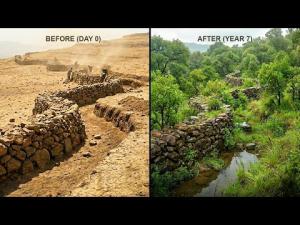 |
Ethiopia Abandoned Tree Planting In The Desert And Did THIS—Nobody Saw This Coming In the scorched highlands of Northern Ethiopia, where the earth had baked into something closer to concrete than soil, thousands of villagers showed up for work. They didn't carry saplings. They carried pickaxes, shovels, and crowbars. And for months, under the skeptical gaze of government officials and the open laughter of neighboring villages, these workers did something that looked completely insane. They dug holes. Millions of them. They excavated over twenty thousand deep trenches. They stacked thirty-eight thousand earthen walls. They assembled four hundred and thirty-nine kilometers of stone barriers—roughly the distance from London to Paris—all by hand. To anyone... |
||
 |
How This Texas Ranch Thrives in Extreme Drought What if adding more cattle actually grew more grass—during a drought? In the middle of an extreme Texas drought, one ranch south of San Antonio is doing the opposite of what you’d expect: running more cattle on less land—and thriving. At Southwest Farms, Lee and Fiona are practicing regenerative grazing that’s restoring soil health, increasing biodiversity, and producing better beef—all while neighboring pastures struggle to survive. This film takes you into the field as they demonstrate cell grazing, hot-wire paddocks, and the core principles of regenerative agriculture—heavy animal impact, long rest periods, and keeping soil covered and alive. In just... |
||
 |
40 Years of Pruning: Why I Stopped Following the Books The difference between an okay harvest and one that has you begging neighbors to take apples off your hands comes down to three cuts that most people skip completely. Every pruning guide out there will tell you to remove dead wood, thin out crossing branches, and keep the center open. And that's all true. But here's what forty years of growing fruit trees has taught me: those basics will get you a healthy tree. They won't get you a heavy producer. |
||
 |
The Legacy of Dr Homer Swingle |
||
 |
What Was Maslin? The Medieval Baker's Famine Proof Bread You've Never Heard Of In 1994, archaeobotanist John Letts was sitting at a desk inside the Oxford University Museum of Natural History when someone handed him a shoebox. Inside was a pile of smoke-blackened straw pulled from the bottom layer of a medieval thatched roof in southern England. He opened the lid and found twenty different types of wheat. Every ear was different. Different heights, different shapes, different colors. All grown together in the same field, harvested together and bundled into the roof of a building sometime around the year 1400. That thatch had been sitting untouched for over 600 years, layer after layer... |
||
 |
The 2,400-Year-Old "Infinite Food" System (That Was Banned) Discover the 2,500-year-old aquaculture system that produces more protein per square foot than cattle ranching—for under $600. Learn how to build a self-sustaining backyard pond that feeds your family fish, eggs, and independence for a decade. This ancient Chinese polyculture method, perfected by Fan Li in 475 BC, was deliberately kept from modern homesteaders. Until now. |
||
 |
Fennel (Foeniculum vulgare) | Essential-Oil-Plant Portrait by Dr. Malte Hozzel Fennel with its latter name “Foeniculum vulgare” belongs to the “apiaceae” family. The name is derived as a diminutive of the latin word “foenom” meaning “hay” which certainly has to do with the grass-like feathery appearance of the leaves. The numerous health benefits of fennel characterise it as an all-around medicinal plant in oil. It is still an indispensable household remedy for many to have at hand at any time. Fennel oil's major virtues are antiseptic and antispasmodic. Fennel unfolds strong relaxing healing powers on nerves muscles and the respiratory tract and also through the spasmodic attacks in case of... |
||
 |
Carl Munck The Code (All Video's) Enhanced Audio/Video If you are interested in ancient knowledge. You should see this video. The face on Mars has a connection with the Earth Grid Matrix just like ALL ancient monumental buildings like Giza, Easter island, Stonehenge, etc etc are connected to form a grid and tell a story. This video take's about 5 hours of your time. but its worth it. |
||
 |
The Forest Underground: Hope for a Planet in Crisis with Tony Rinaudo How do you reforest millions of hectares of African desert without planting a single tree? Find out from Tony Rinaudo, the missionary agronomist who did it. |
||
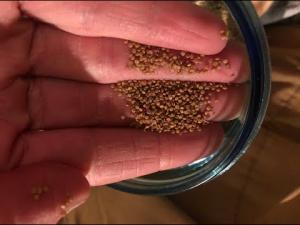 |
Huauzontle Seed Harvest: November 2020 Huauzontle (Chenopodium berlandieri nuttaliae) is a close relative of quinoa (Chenopodium quinoa) and common lamb's quarters (Chenopodium alba). Before the arrival of maize in eastern North America, this species was one of the main grain crops in the eastern agricultural complex. It was domesticated independently both in eastern North America and Mexico from wild pitseed goosefoot (Chenopodium berlandieri). Although the eastern North American domesticated forms eventually went extinct, the Mexican domesticated forms continue to be cultivated in modern times for their greens and young flower buds. Although less commonly done, the seeds can also be steamed and eaten like quinoa.... |
||
 |
More Protein Than Beef, Stronger Than Corn: The Lost Survival Seed. For thousands of years, one tiny desert seed kept entire civilizations alive. It thrived where corn withered, produced more protein than beef, and restored soil without fertilizers. Then history forgot it. Today—thanks to elders, gardeners, and everyday people—it’s finally returning. In this powerful EverGreen Seniors episode, we explore the unbelievable story of the Desert Resilience Bean, an ancient survival seed (Phaseolus acutifolius) built by nature to endure extreme heat, drought, and poor soil. This seed isn’t just history—it’s a solution for modern gardeners, especially seniors who want low-maintenance, high-nutrition crops that thrive with almost no water. You’ll discover how this... |
||
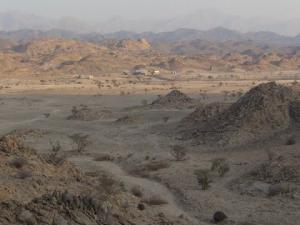 |
The Story of Al Baydha: A Regenerative Agriculture in the Saudi Desert. قصة مشروع البيضاء The final update from Al Baydha Project Co-founder Neal Spackman, 9 years in. How desertification resulted from the loss of an indigenous land management system, and how the land has changed since all inputs to the project were ceased in 2016. Neal moved on from Al Baydha in 2018 and can now be contacted at https://regenerativeresources.co The species that worked the best for us were Ziziphus Spinachristi, Moringa Peregrina, commiphora gileadensis, prosopis spp (though this one we likely won't continue planting in the future), and the local... |
||
 |
How Trees Bring Water Permaculture Instructor Andrew millison explains how trees are connected to water in the atmosphere as well as water flowing through the landscape. This video articulates the amazing role that trees play to ecosystem and climate health, and how their removal causes the drought-flood cycle. There may be some questions about the scientific validity of the concept that forests attract rain. Here are a number of peer reviewed scientific articles to support the hypothesis which suggests that forest cover plays a much greater role in determining rainfall than previously recognized. They explain how forested regions generate large-scale flows in atmospheric water... |
||
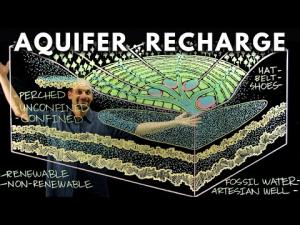 |
How to Rescue a Sinking Water Table Permaculture Instructor Andrew Millison explains the different types of aquifers and the overall strategy for recharging depleted water tables. |
||
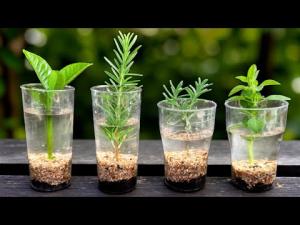 |
Secret that ACCELERATES Rooting in Water - Biological Technique
|
||
![Why It's Also Called "The Miracle Tree!" - [Moringa, Mulakkaya, Murungai, Shevga]](https://aridagriculture.org/system/files/styles/medium/private/video_embed_field_thumbnails/youtube/sJ5Ow71tkGA.jpg) |
Why It's Also Called "The Miracle Tree!" - [Moringa, Mulakkaya, Murungai, Shevga] In India, the moringa plant is known by several names, including: Drumstick: A common name for the moringa plant in India Shevga: A common name for the moringa plant in India Shajan: A common name for the moringa plant in Hindi Murungai: A common name for the moringa plant in Tamil Muringnga: A common name for the moringa plant in Malayalam Munagakaya: A common name for the moringa plant in Telugu Sahjan: A common name for the moringa plant in Hindi/Urdu Mungā: A common name for the moringa plant in Hindi/Urdu |

Feeding People and Livestock with Minimal Water